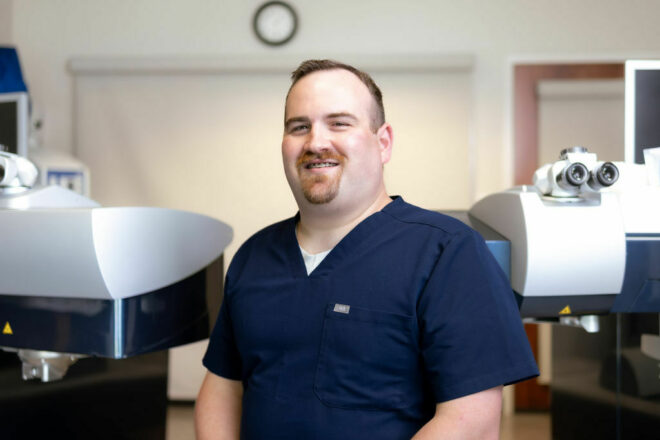
Dr. Ryan Matthews, PRK by Dr. Nunnery 2023
If you’re considering laser vision correction, you’re probably thinking you’ll get LASIK. However, LASIK is not a “one-size-fits-all” procedure. For approximately 25% of patients our surgeons, Dr. Nunnery recommend Photorefractive Keratectomy (PRK) over LASIK. This is typically due to the structural integrity of the cornea.
PRK is an all-laser, no-flap vision correction procedure which utilizes the same laser technology as LASIK to reshape the cornea. The primary difference is that during PRK surgery the surgeon does not create a corneal flap, making this a single laser procedure. This is why it can be referred to as “no-flap LASIK."
During PRK surgery the corneal cover is painlessly removed in about five seconds using a very small gentle “brush.” This cover is the skin layer of the eye that grows back quickly over several days. The cornea is then reshaped using our FDA approved state-of-the-art WaveLight EX500 laser.
If Dr. Nunnery recommends PRK, it is because he is confident this all-laser, no-flap surgery is a safer option for you and will provide a long-lasting result, similar to that of LASIK.
Take Our Vision Correction Self Evaluation Quiz

Dr. Nunnery recommends PRK surgery to approximately 25% of our patients due to one or more of the following reasons:
Both of our surgeons are fellowship trained cornea specialists and are uniquely qualified to detect subtle corneal abnormalities and recommend the safest procedure for you. Meeting your actual laser vision correction surgeon and having a complete and thorough consultation is perhaps the most important part of your vision correction experience. Our team is committed to fully educating you and answering all of your questions about PRK including cost.
At Providence Eye, we have equally excellent results with LASIK and PRK surgery. In fact, Dr. Nunnery had PRK and multiple other Providence Eye team members.
To schedule an appointment, call 704-540-9595 or complete the short form below.